


Inside CNA’s electric vehicle classroom
In a lab at College of the North Atlantic, the conversation about the future of transportation doesn’t start with bold predictions or glossy marketing: it starts with questions.
What exactly is an electric vehicle (EV)? How far can it go? What does it mean for the people who will one day service them?
For Automotive Service Technician Instructor Scott Parsons, those questions are the starting point for something bigger: helping students make sense of a rapidly changing industry.
“There’s a lot of curiosity and a lot of questions around electric vehicles right now,” he says. “What we try to do is break that complexity down into something practical and easy to understand.”
Before diving into the different types of electric vehicles, Parsons starts with a reality his students are already seeing: EVs are becoming more common, and more relevant, every year.
Part of that growth comes down to how EV technology is evolving. Vehicles are now designed to travel hundreds of kilometres on a single charge, with many manufacturers advertising ranges of 400 kilometres or more. However, just as important is how drivers are learning to interact with that technology.
“People are starting to understand how their driving habits affect performance,” Parsons explains. “Things like how you use climate controls, the conditions you’re driving in, and even how you accelerate. It all plays a role.”
That awareness is changing expectations. Features like preconditioning, where drivers can warm or cool the cabin and prepare the battery while the vehicle is still plugged in, are shifting how people think about convenience and efficiency.
At the same time, the variety of EV options now available is making the transition more accessible. From fully electric vehicles to hybrids and extended range models, drivers can choose a system that fits their lifestyle rather than completely changing it overnight.
“There isn’t just one way to go electric anymore,” says Parsons. “There are options that meet people where they are, and that’s a big part of why we’re seeing more of them on the road.”
Inside the classroom, that shift sets the stage for a deeper understanding, one built around five distinct types of electric vehicles. The new curriculum will start being delivered at CNA in September 2026. It’s a way of understanding how the industry is evolving in real time.
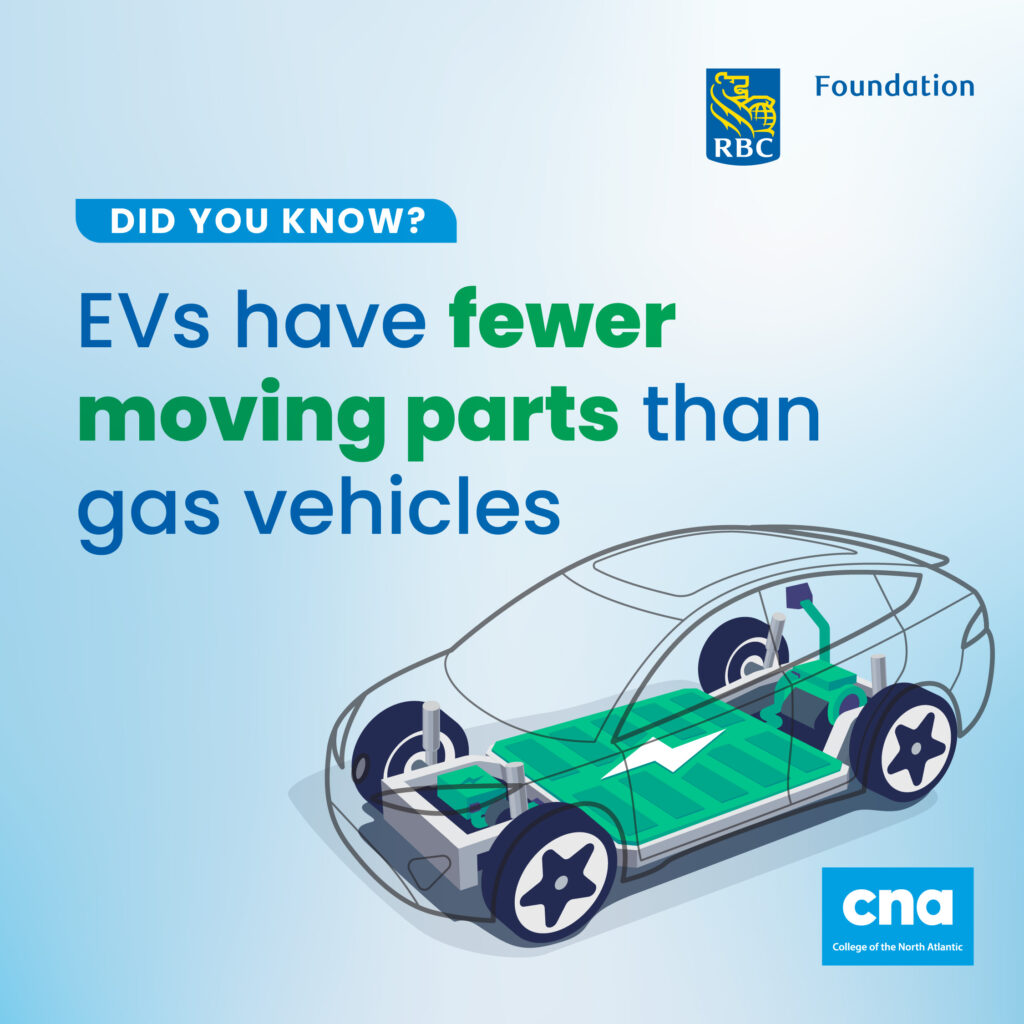
At one end are Battery Electric Vehicles, or BEVs, the fully electric models that have come to define the shift away from traditional engines. With no internal combustion engine, they rely entirely on stored battery power to move.
“These are what most people picture when they think of EVs,” Parsons explains. “They’re fully electric, and everything depends on how efficiently you manage that battery.”
But the reality is more nuanced than a single number on a spec sheet. Range, often advertised at 400 kilometres or more, is shaped by everyday decisions.
“Things like temperature, road conditions, and even how aggressively you drive all impact range,” he says. “It takes a bit of time for drivers to learn how to get the most out of it.”
That learning curve is part of the experience. Owners begin to think differently; planning trips, preconditioning their vehicles while still plugged in, and paying closer attention to how small habits affect performance.
Not every driver is ready to make that leap all at once. That’s where hybrids come in.
Hybrid Electric Vehicles, or HEVs, offer a familiar bridge between old and new. With both a gasoline engine and an electric motor working together, they shift seamlessly between power sources, sometimes using one, sometimes both.
“Hybrids are familiar,” says Parsons. “You fuel them like a traditional vehicle, and the system takes care of the rest.”
There’s no need to plug in. No change to routine. For many, that simplicity is the appeal.
Then there are Plug-In Hybrid Electric Vehicles (PHEVs), which push that idea a step further. They can still rely on gasoline, but they also allow drivers to plug in and travel short distances on electric power alone.
“With a plug-in hybrid, you get the best of both worlds,” Parsons says. “You can drive on electric power for shorter distances and rely on gasoline when you need to go farther.”
In practice, that might mean commuting on electricity during the week and switching to fuel for longer weekend trips, a flexibility that reflects how people actually use their vehicles.
Emerging alongside these are Extended Range Electric Vehicles (EREV), a newer category that’s beginning to find its place in North America. These vehicles run primarily on electricity but include a gasoline-powered generator that can recharge the battery when needed.
“For most daily driving, you’re running fully electric,” Parsons explains. “But for longer trips, the generator eliminates the need to stop and charge.”
With combined ranges that can exceed 700 kilometres, they’re designed to ease one of the most persistent concerns around EVs: the fear of running out of power.
At the far edge of the conversation are Fuel Cell Electric Vehicles (FCEV) and their hybrid counterparts, machines that don’t store electricity in the traditional sense, but generate it using hydrogen.
“Instead of storing electricity, these vehicles generate it on demand using hydrogen and oxygen,” says Parsons.
They remain less common, but their presence in the discussion speaks of something larger: the idea that there isn’t just one path forward. Back in the classroom, that’s the lesson that will matter most.
For students who will be training to become automotive technicians, this isn’t abstract theory. Each system brings its own set of components, its own safety considerations, and its own way of thinking about how a vehicle works.
“Every one of these systems has its own maintenance requirements, its own safety considerations, and its own way of operating,” Parsons says. “Our goal is to make sure students are ready for all of it.”
It’s a mindset that reflects the broader reality of the industry, one defined by a spectrum of solutions evolving at once.
“It’s not just about one type of vehicle taking over,” he adds. “It’s about understanding the full landscape and being able to adapt as the technology evolves.”
For the students listening, that landscape is no longer distant. It’s something they will be preparing to step into one system, one question, one vehicle at a time.
And as Parsons says, understanding is the first step forward.
“Once you understand how these vehicles work, they’re not intimidating,” he says. “They’re just another step forward in how we move from one place to another.”
Sidebar: Why electric vehicles are gaining momentum in Canada
Electric vehicles (EV) are becoming a more common sight on Canadian roads and that shift is being driven by a combination of environmental awareness, advancing technology, and growing public interest.
From an environmental perspective, EVs offer a different approach to transportation by relying on electric motors rather than traditional internal combustion engines. This shift reduces dependence on fuel and reflects a broader movement toward more efficient energy use in everyday driving.
At the same time, adoption is increasing as EV technology becomes more practical. Many vehicles now offer ranges of 400 kilometres or more per charge, making them a realistic option for daily travel. Combined with a growing variety of models, from fully electric vehicles to hybrids and extended-range options, drivers have more flexibility than ever before.
“There isn’t just one way to go electric anymore,” says Parsons. “There are options that meet people where they are, and that’s a big part of why we’re seeing more of them on the road.”
These topics are also explored through CNA’s electric vehicle webinar series, where instructors break down how EV systems work and what drivers can expect in real-world conditions.
“A lot of what we talk about in the webinars comes back to understanding the basics,” Parsons explains. “Once people understand how these vehicles operate, the uncertainty starts to go away.”


