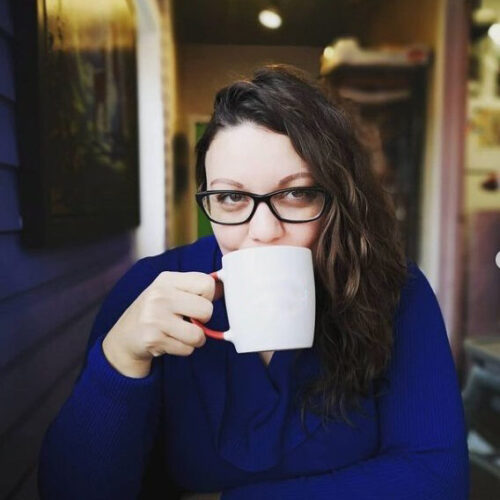


When Lisa Moore picked up the phone and learned she’d been chosen for College of the North Atlantic’s (CNA) Distinguished Acclaim Award, her mind immediately drifted back to a time before book tours and literary prizes—back to her late teens, to Stephenville, and to the art studio that would change her life.
“I was catapulted back to being 17, 18, 19 in Stephenville,” Moore recalls with a laugh. “I remembered the landscape, living in residence, the people I met from every corner of Newfoundland and Labrador. That was one of the richest parts of the experience—all of us talking to each other so we were learning about such very different lives that we were going to be walking into. I think that’s one of the best things that came out of being there and experiencing that world.”
For Moore, one of Canada’s most celebrated authors, those two years in CNA’s Visual Arts program were nothing short of transformative. The multi-disciplinary art program she studied in the early 1980s offered her a creative playground: pottery, painting, drawing, sculpture, jewelry, video, and intermedia.
“We had visiting artists who were just spectacular,” she says. “It was a life-changing experience. That program taught me to experiment with form… so I think I learned there to really think of the term artist as really just making something meaningful that captures a moment in time and shows us at least what it means to be human.”
From brushes to books
Moore may be best known today for her fiction—acclaimed novels like February and Caught—but her artistic roots run deep in the visual arts.
“Even when I was painting,” she says, “I was thinking how do I tell the story… there’s more than just the image. I was passionate about language and how it could communicate (emotion and meaning).”
That desire to tell stories, to shape narratives that reveal something essential about people and place, eventually led her to writing full-time. Yet she never abandoned her early lessons from CNA.
Finding voice in a changing landscape
When Moore began writing, Newfoundland and Labrador authors rarely found recognition beyond the island.
“You know, I think there was always a rich culture of writing here in Newfoundland, but it was it was difficult to get your work published outside the province,” she says. “That changed when writers like Annie Proulx wrote The Shipping News and Wayne Johnston wrote Colony of Unrequired Dreams – suddenly there was a lot of interest.”
While Moore herself would become part of that wave – helping define a new literary era for Newfoundland and Labrador – she got her start sending writings out to literary journals. Now, her works which often deeply rooted in the province’s social and political realities, explore both the beauty and hardship of life here. February, for instance, is a novel born out of the Ocean Ranger tragedy; Caught examines surveillance, freedom, and moral complexity.
“I think beauty is radical,” Moore says. “I think it’s politically radical, emotionally radical. I think it’s, beautiful when we experience it, when we recognize it, when it astonishes us and surprises us – I think that changes us and it makes us better.
A teacher’s heart
In addition to her writing, Moore is known as a passionate mentor and Full Professor at Memorial University, where she helps emerging writers find their voices. Her students speak often about her generosity—of time, of spirit, of belief.
“I think teaching is creative work,” she explains. “We learn from each other. Students learn from professors, and professors learn from students. It allows you to stay in touch with the aching, wild, magical life that is what happens when you experience the world as a young person. You see that and there are moments of such intensity and excitement about writing – it’s thrilling to be around.”
Her approach to teaching is deceptively simple – confidence is already inside every student.
“They just need to hear, ‘You can do this.’” It’s not just me. It’s the whole class reading the stories and telling each other what they think. It’s that community that builds confidence in each of the writers in the classroom. The skills are just like other crafts and sciences. – there are rules. The rules can be broken.”
However, Moore’s the first to admit she has learned as much from her students as they have from her.
“I’ve learned to persevere. I‘ve learned patience because it takes patience to make a work of art. You have to be willing to fail and try again and fail and try again. Fail better as they say. I don’t mean that my students are failing. They’re definitely not, but what they are doing is experimenting. And if you really do experiment, you’re going to make mistakes. And those mistakes teach us as much as if it came out perfectly the first time the pen touches a page and sometimes it does.”
The art of reflection
Ask Moore what the arts mean to a community, and she answers without hesitation. “I think the arts really strengthen local communities because they reflect us,” she says. “They show us where we’re going wrong, what we’re doing right. They celebrate moments of joy, they show us how to love and show us empathy. They teach us to care for the plant and even care for the lives that we are living.
“So much of our time is spent racing forward. Chasing something that we can’t, we don’t even have time to acknowledge what it is we’re chasing and so I think art makes us reflect and understand where we are and who we are.”
Her own sense of place—Newfoundland’s rugged coastlines, its humour, its endurance—shines through her work. But Moore’s ambitions reach beyond geography.
“I think about the kind of stories that explore the moment that we’re in… today we’re asking ourselves, ‘how do we get where we are?’ Regardless of where you are in the world, where you’ve come from, where you’ve gone to the place that find yourself, and the moment that you’re in, it takes a tremendous amount of attention to understand the place where we are, to experience it. I think it’s important to write about that. I think that’s what makes a good story.”
A life remembered, a legacy in motion
Receiving CNA’s Distinguished Acclaim Award has given Moore a moment to look back on the path that began in a Stephenville studio, under high windows and the swirl of winter storms outside where, as a teenager, she first learned what it meant to live and breathe art.
“One of my beautiful memories from CNA is painting late into the night in that huge studio – it was open to us 24 hours a day,” she recalls. “Everyone was working, the snow was flying by (the window) and to me, it seemed to me like that was the most romantic making art could ever be.”
Reflecting on her legacy, Moore is characteristically humble. “I’d like it to be that stories keep coming,” she says. “Newfoundland doesn’t need me for that—the stories will keep coming and they’re going to be richer and deeper as time goes on.”
Looking back, Moore is quick to credit CNA with showing her that an artistic life was possible. “I absolutely believe that going to the College of the North Atlantic opened up the world for me,” she says. “It made me realize that being an artist wasn’t just a dream—it could be a life.”
Her time in Stephenville was very powerful and she credits it with shaping her to become the artist she is.
“You know, it, it guided everything that I did as I went on. I really learned that in order to make art, you have to try to break molds. You have to try to think new things, which is almost impossible, but you’ve to try anyway. And I guess that experience broke open this eggshell of everything I did afterwards.
Words for the next generation
Moore’s advice for today’s students is simple, yet profound. “Do what excites you. Do what makes you curious. If someone says there’s no money in it, do it anyway,” she says with a smile. “We just don’t know what’s going to be making money, and we don’t know where that will lead us. But we do know that if you follow your passion and, and what excites you, there’s so much drive behind that kind of a desire to learn, to know, to find out what you’re curious about. I think it’s the best path.”
And for Lisa, that path began at College of the North Atlantic—with brushes, clay, and canvas; with community and courage; with the spark of creativity that would go on to illuminate Canadian literature.
“I absolutely believe that going to College of the North Atlantic opened up the world of art for me,” she says. “It made me realize what I absolutely wanted to do. I knew once I had done those two years that I would be doing this kind of work.”